* All product/brand names, logos, and trademarks are property of their respective owners.
Pakistan’s shift toward electric vehicles is picking up pace—and GAC looks ready to join the race at just the right time. With fuel prices still unpredictable and interest in EVs steadily growing, every new entrant has the potential to reshape buyer choices. Now, fresh teaser activity from GAC suggests its long-expected arrival in Pakistan is moving closer to reality.
Backed by Lucky Motor Corporation, which recently secured rights to bring GAC’s AION and HYPTEC brands into the country, the company has started hinting at its first electric models through social media teasers. While official details like pricing and launch dates are still under wraps, early signs point to an electric SUV and a sedan leading the lineup. For Pakistani buyers watching the EV space, this isn’t just another brand entry—it could signal more competition, better options, and possibly more accessible electric mobility in the near future.
GAC’s teaser campaign gives the clearest signal yet that its Pakistan launch is no longer just a plan—it’s in motion. Following the partnership with Lucky Motor Corporation, the brand has started building anticipation through short, cryptic social media posts that hint at what’s coming next.
While GAC hasn’t officially named the vehicles, the teasers strongly suggest a two-model entry strategy: an electric SUV and an electric sedan. This approach makes sense for Pakistan, where SUVs dominate buyer interest, while sedans still appeal to those looking for practicality and efficiency.
The messaging used in the teasers—phrases like “Something powerful is on the horizon”—leans heavily on performance and innovation, which aligns with GAC’s global positioning in the EV space. It’s not just about entering the market, but doing so with vehicles that feel modern, tech-focused, and competitive.
What’s also notable is the timing. GAC is stepping in when:
Instead of launching quietly, GAC appears to be building momentum early—creating curiosity before revealing full details like pricing, variants, and availability.
At this stage, the company is keeping things deliberately vague. But based on global models and the teaser visuals, there’s already a strong indication of what Pakistani buyers can expect next.
At this point, GAC has created curiosity without confirming the final Pakistan-spec lineup. The official part is straightforward: Lucky Motor Corporation has secured the rights to introduce GAC’s Aion and Hyptec new-energy brands in Pakistan, and the company says its commercial rollout plan, product portfolio, technology plans, and dealership network will be announced in the coming weeks.
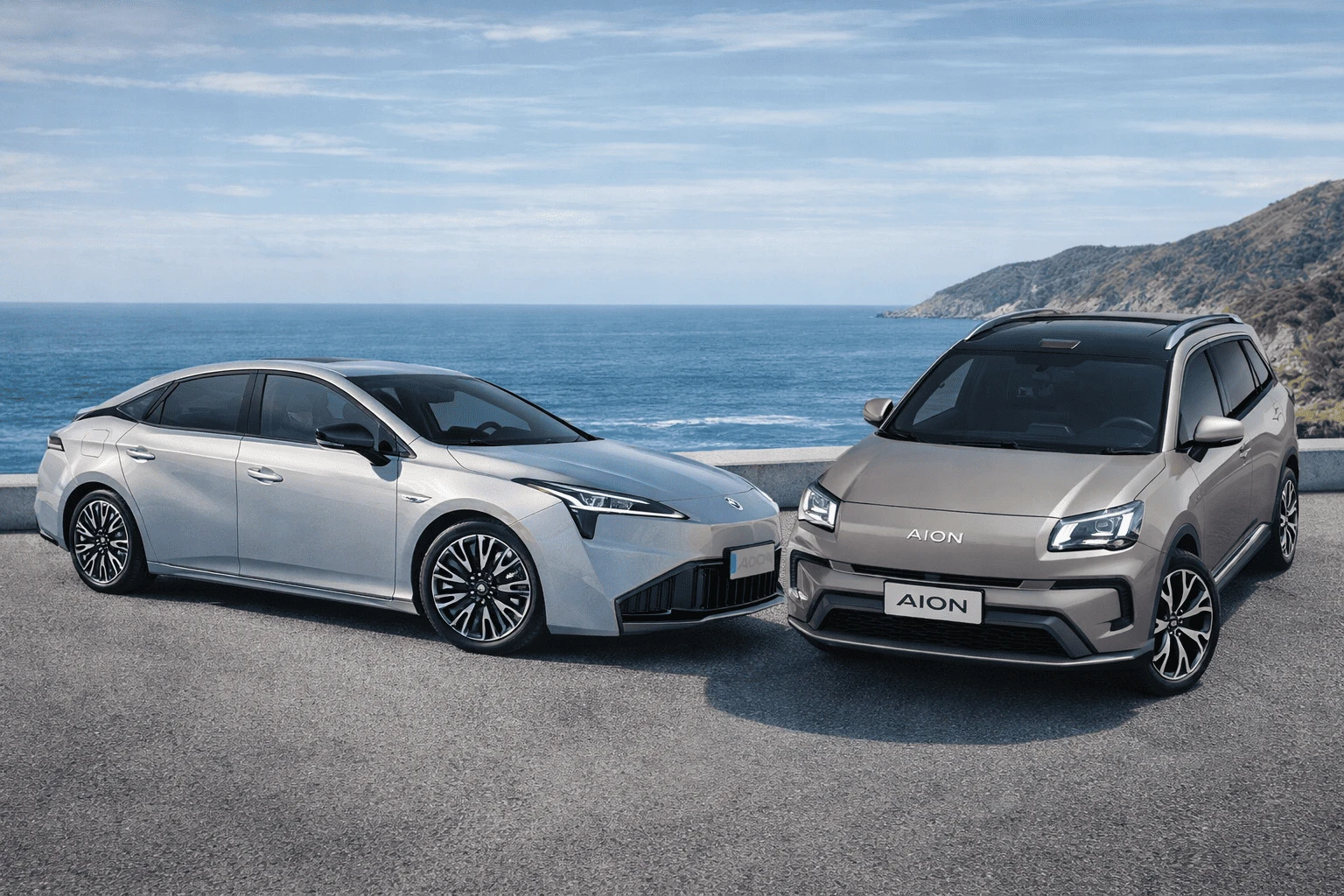
What the teasers appear to show, however, is a likely two-body-style launch strategy:
That matters because it suggests GAC may be trying to cover two key buyer groups from day one: families who prefer SUVs and buyers who still want the familiar shape and practicality of a sedan. That would be a smart move in Pakistan, where SUVs get more attention, but sedans still make sense for commuters and fleet-style use. This is an inference based on the apparent vehicle shapes and current market logic, not an official model confirmation.
There is also an important detail readers should keep in mind: Aion and Hyptec are confirmed, but the exact model names are not. Local reports and visual comparisons have linked the teased vehicles to models already sold internationally, but GAC and Lucky Motor have not yet released a Pakistan-specific list of variants, trims, battery sizes, or badges. So for now, any model identification should be treated as an informed early read, not a final announcement.
In simple terms, the teasers reveal momentum more than specifications. They show that GAC is actively building its presence, but buyers still have to wait for the details that matter most: which models are coming, what features they will get, how far they will go on a charge, and how much they will cost in Pakistan.
While GAC hasn’t officially confirmed the Pakistan lineup yet, the teaser visuals strongly align with two globally available models: the AION V (SUV) and AION ES (sedan). These are the most likely candidates based on design cues and GAC’s existing EV portfolio.
Here’s a fact-based snapshot of their international specifications:
| Model | Type | Battery | Range (Est.) | Power |
|---|---|---|---|---|
| AION V | Electric SUV | 64.5–75.2 kWh | Up to 600 km (NEDC) | ~200 hp |
| AION ES | Electric Sedan | ~55.2 kWh | Up to 440 km (NEDC) | ~134 hp |
Note: Final Pakistan-spec versions may differ in battery size, features, and range.

The AION V is likely to be the headline model for Pakistan, mainly because SUVs dominate local buyer preferences.
What stands out:
If priced competitively, it could directly challenge vehicles like the MG ZS EV and BYD Atto 3.

The AION ES targets a different type of buyer—those who want efficiency, simplicity, and lower running costs.
Key highlights:
Instead of just numbers, here’s how this translates for Pakistani drivers:
Overall, if these models launch with similar specs, GAC could offer a balanced mix of range, practicality, and modern features—something the current EV market in Pakistan is still developing.
Pricing will be one of the biggest deciding factors for GAC’s success in Pakistan. While no official figures have been announced yet, we can make realistic estimates based on global pricing, import duties, and how current EVs are positioned locally.
These are informed estimates based on international pricing and Pakistan’s current EV market. Final prices may vary depending on local assembly plans, taxes, and feature levels.
For Pakistani buyers, EV pricing isn’t just about the sticker price. It connects directly to:
This is where GAC has an opportunity. If it can balance:
It could attract buyers who are currently undecided between traditional hybrids and full EVs.
At the end of the day, pricing will determine whether GAC becomes a serious competitor or just another premium option in a still-developing EV market.
With GAC preparing to enter the market, it will face direct competition from a small but growing group of EV players already present in Pakistan. Each brand has carved out its own position—but there’s still room for disruption.
Here’s how GAC could stack up:
| Brand | Key Models | Segment | Price Range (PKR) | Strength |
|---|---|---|---|---|
| MG | ZS EV | SUV | ~1.2–1.3 crore | First-mover advantage, strong brand recall |
| BYD | Atto 3, Dolphin | SUV / Hatchback | ~1.0–1.5 crore | Advanced tech, global EV leader |
| Hyundai | Ioniq (limited presence) | Sedan | ~1.0+ crore | Proven efficiency, brand trust |
| GAC (Expected) | AION V, AION ES | SUV / Sedan | ~80 lakh – 1.4 crore | Range + features + fresh competition |
Explore Autodost Comparisons category for detailed vehicle comparisons and complete car information.
GAC’s biggest opportunity lies in value positioning—offering more features and range at a similar or slightly lower price.
Potential advantages:
For buyers comparing options, GAC could become attractive if:
If it fails in these areas, buyers may stick with known brands, even if they’re slightly more expensive.
Overall, GAC isn’t entering an empty market—but it is entering one that’s still forming. That gives it a real chance to shake things up if it gets the basics right.
Pakistan’s EV market is still in its early stages, but the direction is becoming clearer with each new entrant. GAC’s arrival is part of a broader shift that’s slowly reshaping how people think about cars, fuel, and long-term ownership.
Interest in electric vehicles is no longer limited to early adopters.
While total numbers are still small, the trend is moving upward.
Pakistan is not switching to electric overnight. But the shift has clearly started.
Each new launch—like GAC’s—adds momentum. Over time, this could lead to:
GAC teasing its first electric vehicles for Pakistan signals more than just a new product launch—it reflects a market that’s slowly opening up to real competition in the EV space. With likely entries like the AION V and AION ES, the brand appears ready to offer a mix of range, modern features, and broader choice for local buyers.
A lot still depends on the final details—especially pricing, specifications, and after-sales support. But even at this stage, one thing is clear: the arrival of GAC electric vehicles in Pakistan could push the market forward, giving buyers more options and encouraging stronger competition among existing players.
For now, it’s a waiting game. But if the launch delivers on expectations, GAC might not just enter the market—it could become a serious contender in Pakistan’s evolving EV landscape.

I am Zeenat, an SEO Specialist and Content Writer specializing in on-page and off-page SEO to improve website visibility, user experience, and performance.
I optimize website content, meta elements, and site structure, and implement effective off-page SEO strategies, including link building and authority development. Through keyword research and performance analysis, I drive targeted organic traffic and improve search rankings.
I create high-quality, search-optimized content using data-driven, white-hat SEO practices, focused on delivering sustainable, long-term growth and improved online visibility.
Buying an EV in Pakistan is no longer just a futuristic idea. More electric cars are entering the lo
1 June 2026
The BYD Shark 6 is one of the most talked-about new utes on the market right now, and for good reaso
21 May 2026
The Suzuki Fronx officially launched in Pakistan on 6 May 2026, entering the growing compact crossov
8 May 2026
Be the first to share your thoughts
No comments yet. Be the first to comment!
Share your thoughts and join the discussion below.