* All product/brand names, logos, and trademarks are property of their respective owners.
Most people still think of cars as simple machines — something you drive from point A to point B. But that idea is outdated.
Modern vehicles are no longer just mechanical systems. They’re packed with intelligent technology that quietly works in the background, making decisions, solving problems, and even predicting what might happen next on the road.
What’s surprising is this: many drivers use these smart car features every single day without realizing how advanced they really are.
From automatically adjusting your speed in traffic to helping you stay in your lane, today’s cars are doing far more thinking than we give them credit for. And once you start noticing it, you’ll see that your car isn’t just assisting you — it’s actively working with you.
What many drivers don’t realize about the technology inside their cars is that modern vehicles are constantly reading, measuring, and reacting to what’s happening around them.
Even when you feel like you’re doing all the work, your car may already be tracking road markings, checking the distance to the vehicle ahead, monitoring tire pressure, adjusting engine performance, and watching for anything unusual. A lot of this happens in seconds, with no dramatic warning lights or obvious alerts.
That is what makes modern cars feel so different from older ones. They are not just following your commands. They are also processing information in real time and helping you make safer, smoother decisions.
Here are a few simple examples of that hidden intelligence:
The biggest reason many people overlook this is that the technology is designed to feel natural. It does not always interrupt you. It steps in quietly, supports your driving, and often solves small problems before you even notice them.
So while it may not look like your car is “thinking,” that is exactly what many modern vehicles are doing every time you start the engine.
Modern cars do not feel smart just because they have screens, buttons, or fancy dashboards. The real proof is in the features that actively help you while you drive. These systems are designed to notice things faster, respond earlier, and reduce the number of mistakes that happen on the road.
Parking has always been one of the most stressful parts of driving, especially in tight spaces. Modern cars make this much easier with parking sensors, rear cameras, and in some cases full 360-degree views.
These systems can:
In real life, this means your car may notice an obstacle before you do, especially when reversing in a crowded parking area.
Lane assist is one of the clearest examples of intelligent driving support. Using cameras and sensors, the system watches lane markings and notices when the vehicle starts to drift without a signal.
When that happens, the car may:
It feels small in the moment, but this feature can make a big difference on long drives or during moments when the driver loses focus for a second.
Traditional cruise control keeps the car at a fixed speed. Adaptive cruise control goes much further. It tracks the traffic ahead and automatically adjusts speed to keep a safe distance from the vehicle in front.
That means it can:
This is one of the best examples of how modern car technology does not just obey commands. It also reacts to changing road conditions in real time.
Automatic emergency braking is one of the strongest examples of why modern cars are smarter than many people think. The system uses sensors, radar, or cameras to detect a possible collision.
If the driver does not respond fast enough, the car may:
Human reaction time has limits. A smart safety system does not get distracted, tired, or slow to respond. That can be the difference between a close call and a serious accident.
These features are not futuristic ideas anymore. They are already part of everyday driving in many vehicles. And once you look closely, the proof becomes obvious: modern cars are doing much more than moving forward. They are watching, calculating, assisting, and stepping in when it matters most.
It might sound strange to say a car can “think,” but once you understand what’s happening behind the scenes, it starts to make sense.
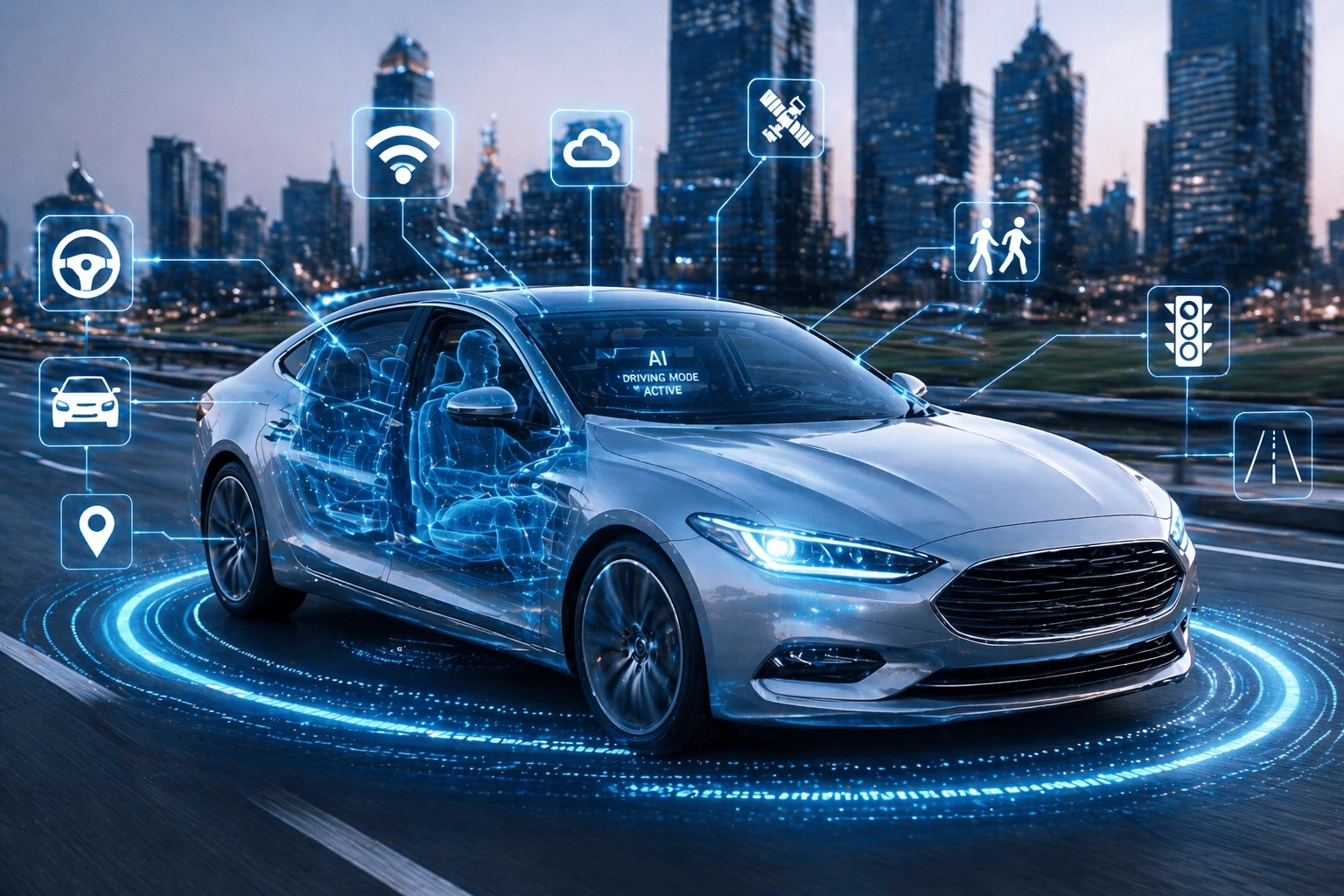
Modern cars don’t have brains like humans. Instead, they rely on a combination of sensors, cameras, software, and onboard computers that work together in real time.
Here’s a simple way to understand it:
Sensors are placed all around the vehicle. They constantly collect data about the environment.
They can detect:
Without these, the car would be “blind” to what’s happening around it.
Cameras help the car see lane markings, traffic signs, and movement around it.
They are used for:
This visual input allows the car to understand the road in a way similar to how drivers do.
This is where everything comes together.
The car’s computer processes data from sensors and cameras in milliseconds. It decides:
All of this happens instantly, without needing internet in most cases.
Modern vehicles use smart algorithms (and in some cases AI) to improve decision-making.
This allows the car to:
Imagine you’re driving in traffic and the car ahead suddenly slows down.
Here’s what your car does in seconds:
You may only notice the slowdown — but behind the scenes, your car just performed a rapid chain of decisions.
works in the background, helping you drive better, safer, and with less effort.
And that’s the real meaning of a “smart” car — not one that replaces the driver, but one that constantly supports them.
One of the easiest ways to understand how far technology has come is to compare older vehicles with today’s smart cars side by side.
Here’s a clear breakdown:
| Feature | Old Cars | Modern Smart Cars |
|---|---|---|
| Safety | Basic airbags, seatbelts | Automatic emergency braking, collision warnings, blind-spot detection |
| Driving Assistance | Fully manual driving | Lane assist, adaptive cruise control, parking assist |
| Awareness | Depends entirely on driver | 360° sensors, cameras, real-time monitoring |
| Connectivity | No connectivity | GPS, smartphone integration, live updates |
| Efficiency | Fixed performance | Smart fuel optimization, driving behavior tracking |
The gap isn’t just about more features — it’s about how the car supports the driver.
In older cars:
In modern smart cars:
This shift has changed driving from a fully manual task into a shared effort between human and machine.
And once you experience both, the difference becomes impossible to ignore.
All this technology sounds impressive, but what really matters is how it affects your everyday driving.
The impact is more practical than most people expect:
In simple terms, modern cars don’t just add convenience — they make driving safer, smoother, and more predictable.
Modern cars are far more intelligent than they appear on the surface. What feels like a normal driving experience is actually supported by a network of systems constantly analyzing, adjusting, and assisting in real time.
From subtle steering corrections to life-saving emergency braking, these smart car features are already proving their value every day. The surprising part is not that this technology exists — it’s that so many drivers are using it without fully realizing it.
Once you start paying attention, it becomes clear: your car isn’t just responding to your inputs. It’s actively working alongside you, helping you make better decisions on the road.
And that’s the real proof — modern cars aren’t just smarter than before… they’re smarter than most people think.

I am Zeenat, an SEO Specialist and Content Writer specializing in on-page and off-page SEO to improve website visibility, user experience, and performance.
I optimize website content, meta elements, and site structure, and implement effective off-page SEO strategies, including link building and authority development. Through keyword research and performance analysis, I drive targeted organic traffic and improve search rankings.
I create high-quality, search-optimized content using data-driven, white-hat SEO practices, focused on delivering sustainable, long-term growth and improved online visibility.
Pakistani car buyers are hearing more about EVs, hybrids, plug-in hybrids, range extenders, new ener
4 June 2026
Auto tech innovations in Pakistan are changing the way people think about driving, safety, fuel savi
26 May 2026
Not long ago, driving meant full control—hands on the steering wheel, eyes on the road, and ev
1 May 2026
Be the first to share your thoughts
No comments yet. Be the first to comment!
Share your thoughts and join the discussion below.