* All product/brand names, logos, and trademarks are property of their respective owners.
When you're in the market for a car, one of the first decisions you’ll face is whether to go for a manual or automatic transmission. It might sound like a simple choice — but for most buyers, it’s not just about comfort or driving style. It’s about fuel efficiency, maintenance cost, traffic conditions, and how much control you want behind the wheel. Especially in countries like Pakistan, where city traffic is hectic, fuel prices are rising, and car ownership is a serious investment, the decision between manual and automatic cars deserves some real thought.
So, what’s the big deal? Manual cars have been around for decades and are often praised for giving drivers full control and better mileage. On the other hand, automatic cars have surged in popularity in recent years, mainly because they’re easier to drive — particularly in stop-and-go traffic.
But there’s more to the story.
Beyond just the gearstick and clutch pedal, there are other factors that can influence your decision. Which one is cheaper to maintain? Which one is better for long-term use? And if you’re buying a used car in Pakistan, which type holds its value better?
In this blog, we’re breaking it all down in a clear, simple, no-jargon way. Whether you’re a first-time buyer or thinking of switching from manual to automatic (or vice versa), we’ll help you understand the key differences, explore the pros and cons, and figure out which one is best suited for your driving needs, budget, and local environment.
Let’s dive into the world of manual vs automatic cars — and help you make a smart, confident decision.
When it comes to understanding the difference between manual and automatic cars, it all starts with how the car changes gears — and how much the driver is involved in that process. While both serve the same purpose, they offer very different driving experiences, especially in countries like Pakistan where traffic, road conditions, and budget play a huge role in choosing the right type.
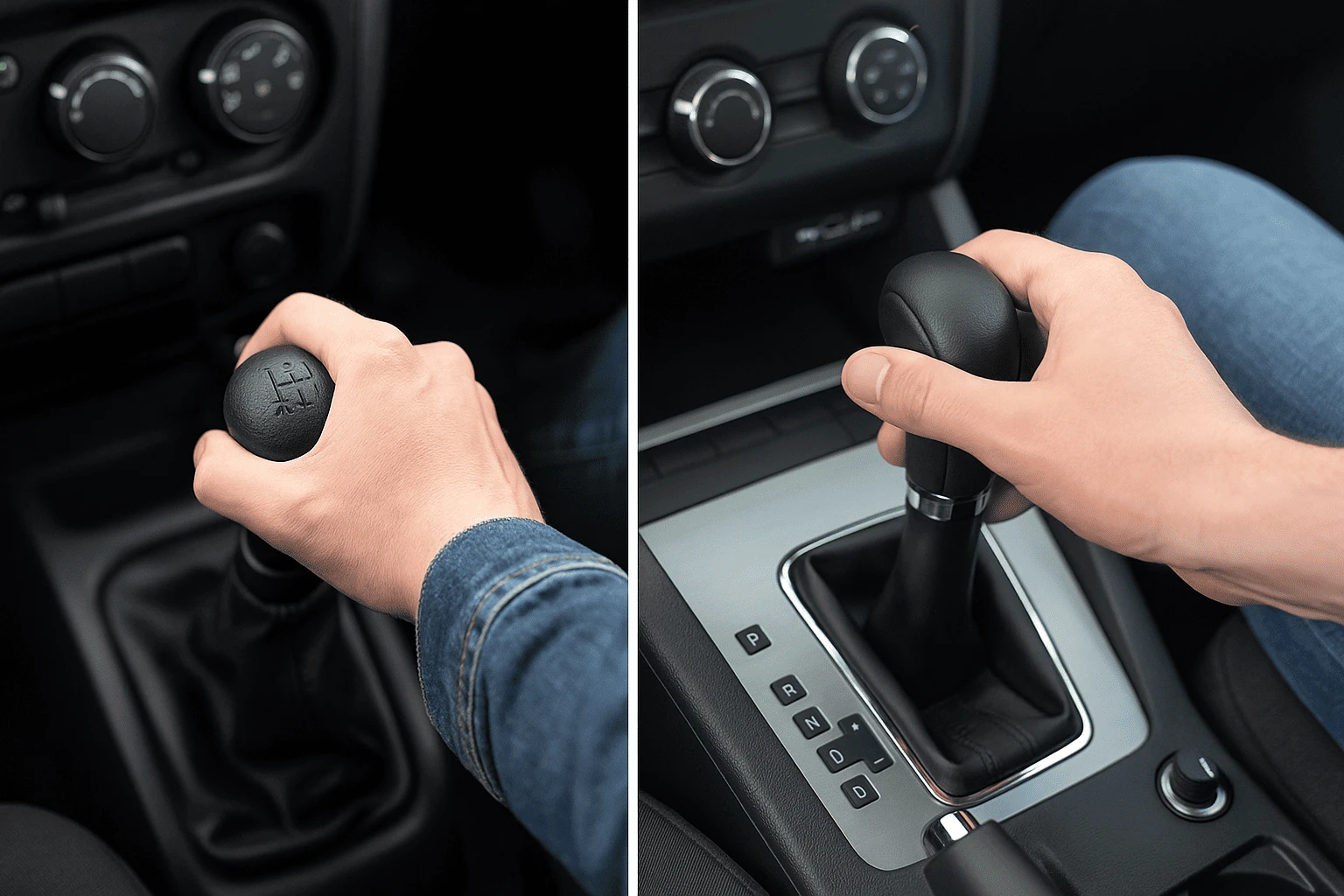
A manual transmission, also known as a “stick shift,” puts the driver fully in control of changing gears. You’ll find a clutch pedal on the floor, which you press every time you shift gears using the gear stick. It might take a little practice, especially for beginners, but many drivers love the engagement and control a manual car offers.
In Pakistan, manual cars are often the more affordable choice, especially when buying a new or used vehicle. They’re known for:
Better fuel efficiency (in most cases)
Lower maintenance costs
Easier access to mechanics and spare parts
However, driving a manual in stop-and-go city traffic (like in Karachi or Lahore) can become tiring — the constant need to clutch and shift can make the daily commute frustrating.
An automatic transmission does all the gear-shifting for you. There’s no clutch pedal — just the accelerator and brake. It’s a smoother, more relaxed experience, especially for those who drive in congested urban areas.
For beginners, automatics are easier to learn. They're great for drivers who prioritize comfort, convenience, and less physical effort while driving.
In recent years, the availability of automatic cars in Pakistan has increased — especially in mid-range sedans, compact SUVs, and hybrids. However, they do come with:
Higher purchase prices
Slightly more expensive maintenance
Not all automatics are the same. Here are a few types gaining traction:
CVT (Continuously Variable Transmission): Found in many fuel-efficient cars like the Toyota Vitz or hybrid models. Offers smoother acceleration, good for city driving.
AMT (Automated Manual Transmission): A budget-friendly automatic system — works like a manual underneath but shifts gears automatically. Popular in small cars like Suzuki Cultus AGS in Pakistan.
DCT (Dual Clutch Transmission): High-performance and quick-shifting — usually seen in luxury or sporty models, but starting to appear in mid-range cars.
Each has its own pros and cons, and knowing which one you're getting can help you make a smarter choice.
Now that we’ve explained how both transmissions work, let’s get into what really matters for daily drivers — the real-world pros and cons of owning a manual vs an automatic car. This section focuses on the factors that most drivers in Pakistan think about: fuel efficiency, maintenance cost, comfort, and resale value.
| Feature | Manual Cars – Pros | Manual Cars – Cons | Automatic Cars – Pros | Automatic Cars – Cons |
|---|---|---|---|---|
| Fuel Efficiency | Better fuel economy (especially on highways) | Less efficient in heavy traffic | Easier on fuel in modern systems (CVT, AMT) | Older automatics consume more fuel |
| Purchase Cost | Lower initial price used cars(PKR 400k–6500k cheaper) | N/A | Convenient but more expensive upfront | Higher purchase cost |
| Maintenance | Easy to repair; cheaper parts; widely available mechanics | Clutch replacement is needed after wear | No clutch; less frequent gear repair needed | Costly repairs; parts can be hard to find in Pakistan |
| Driving Experience | Full control; responsive driving | Requires skill, can stall if mishandled | Easy to drive; ideal for beginners | Less control; can feel sluggish in low-end models |
| Comfort in Traffic | Tiring in stop-and-go traffic | Constant clutch use can cause fatigue | Stress-free in urban traffic | May lag in performance if poorly maintained |
| Learning Curve | Takes time to master gear shifting | Not beginner-friendly | Great for learners | Drivers may get too dependent, less engaged |
| Resale Value | High in rural areas; budget-friendly segment | Less demand in urban markets | Growing resale value in cities | Lower resale in rural areas |
| Spare Parts Availability | Easily available, cheaper | N/A | Improving, especially for popular models | Some parts (e.g., CVT) are costly or imported |
| Driving Terrain Suitability | Great for hilly, mixed terrain | Tough for beginners in steep traffic areas | Best for city and flat terrain | May struggle in rough terrain without manual override |
One of the most critical factors for car buyers — especially in Pakistan — is fuel economy. Generally speaking, manual cars tend to be more fuel-efficient than their automatic counterparts. This is because they allow the driver to control gear changes based on road conditions and engine load.
Often deliver better mileage, especially on long routes.
Lower initial cost (manual versions of the same car can be PKR 100,000–250,000 cheaper).
Maintenance is simpler and cheaper — especially clutch systems and gearboxes.
Most mechanics across Pakistan are more familiar with manual transmissions.
Slightly lower mileage in older or low-end automatics, but modern CVT and AMT systems are closing that gap.
Higher maintenance costs, especially if transmission repairs are needed.
In some areas, finding a skilled mechanic for CVT or DCT gearboxes can be tough.
Spare parts for automatic gearboxes tend to be more expensive.
In summary: Manual cars win on fuel and maintenance savings, but automatics offer comfort at a price.
If you’ve ever driven through the bumper-to-bumper traffic of Lahore, Karachi, or Islamabad, you’ll understand why automatic cars are becoming more popular. They remove the constant need to press the clutch and shift gears, reducing fatigue and improving focus.
Effortless to drive, especially in congested areas.
Better for new drivers and learners.
Easier for older people or those with leg/knee problems.
Gives the driver full control over gear shifts — great for hilly terrain or highways.
Some drivers enjoy the "feel" of manual driving.
Generally more responsive if driven well.
The Trade-off:
Manual = more control, but more effort.
Automatic = more comfort, but less driver engagement.
Manual cars typically have better resale value in rural and semi-urban markets, where most buyers are looking for budget-friendly and low-maintenance vehicles. Spare parts are easier to find, and repairs are cheaper.
Automatic cars, while gaining ground, still face skepticism in some parts of Pakistan. However, in urban centers, the demand for automatics is growing steadily — especially among younger buyers and families.
Key Points:
Manual cars are easier and cheaper to repair.
Automatic car resale value depends on model and condition — newer automatics fare better.
Some automatic parts (like CVT belts or electronic modules) can be costly or hard to source locally.
So, after breaking down the manual vs automatic car debate, the answer isn’t black and white — it depends on you, your driving habits, budget, and where you live.
If you’re someone who mostly drives on highways, values fuel efficiency, and doesn’t mind a bit of legwork, a manual car might suit you better. It offers greater control, lower maintenance costs, and is generally more affordable to buy. In places like smaller cities or rural areas of Pakistan, manual cars still dominate because they’re easy to fix, parts are widely available, and mechanics know them well.
But if you spend your weekdays stuck in Lahore’s or Karachi’s chaotic traffic, you’ll likely appreciate the ease and comfort of an automatic. No clutch to press. No gear shifting every 10 seconds. Just a smoother, less stressful ride — especially on jam-packed roads. Automatic cars may cost more upfront and in maintenance, but for many, the convenience is worth every rupee.
There’s also a middle path — with options like AMT or CVT transmissions giving you a mix of manual control and automatic comfort, now available in many Pakistani car models (like Suzuki Cultus AGS, Toyota Vitz CVT, etc.).
TL;DR — Manual vs Automatic in Pakistan:
| Situation | Better Option |
|---|---|
| Long highway driving | Manual |
| Daily city traffic | Automatic |
| Low budget, high resale priority | Manual |
| Beginner or learner driver | Automatic |
| Rural driving or poor roads | Manual |
| Prioritize ease & less fatigue | Automatic |
At the end of the day, it’s not about what’s best overall, but what’s best for you.
Whether you value fuel savings, ease of use, or long-term maintenance, understanding these differences helps you make a smart, confident decision.
So — what’s your pick? Are you Team Manual or Team Automatic?
Let us know your thoughts in the comments!

I am Zeenat, an SEO Specialist and Content Writer specializing in on-page and off-page SEO to improve website visibility, user experience, and performance.
I optimize website content, meta elements, and site structure, and implement effective off-page SEO strategies, including link building and authority development. Through keyword research and performance analysis, I drive targeted organic traffic and improve search rankings.
I create high-quality, search-optimized content using data-driven, white-hat SEO practices, focused on delivering sustainable, long-term growth and improved online visibility.
Fuel prices, new car launches, and growing interest in cleaner transport have made many buyers compa
25 May 2026
For years, the Toyota Fortuner has dominated Pakistan’s premium SUV market. If you had a budge
15 April 2026
When it comes to compact sedans, few rivalries are as deeply rooted in Pakistan’s automotive c
21 January 2026
Be the first to share your thoughts
No comments yet. Be the first to comment!
Share your thoughts and join the discussion below.

(1).webp&w=3840&q=75)