* All product/brand names, logos, and trademarks are property of their respective owners.
For years, the Toyota Fortuner has dominated Pakistan’s premium SUV market. If you had a budget around PKR 2 crore, the decision was simple — Fortuner was the default choice.
But things are changing in 2026.
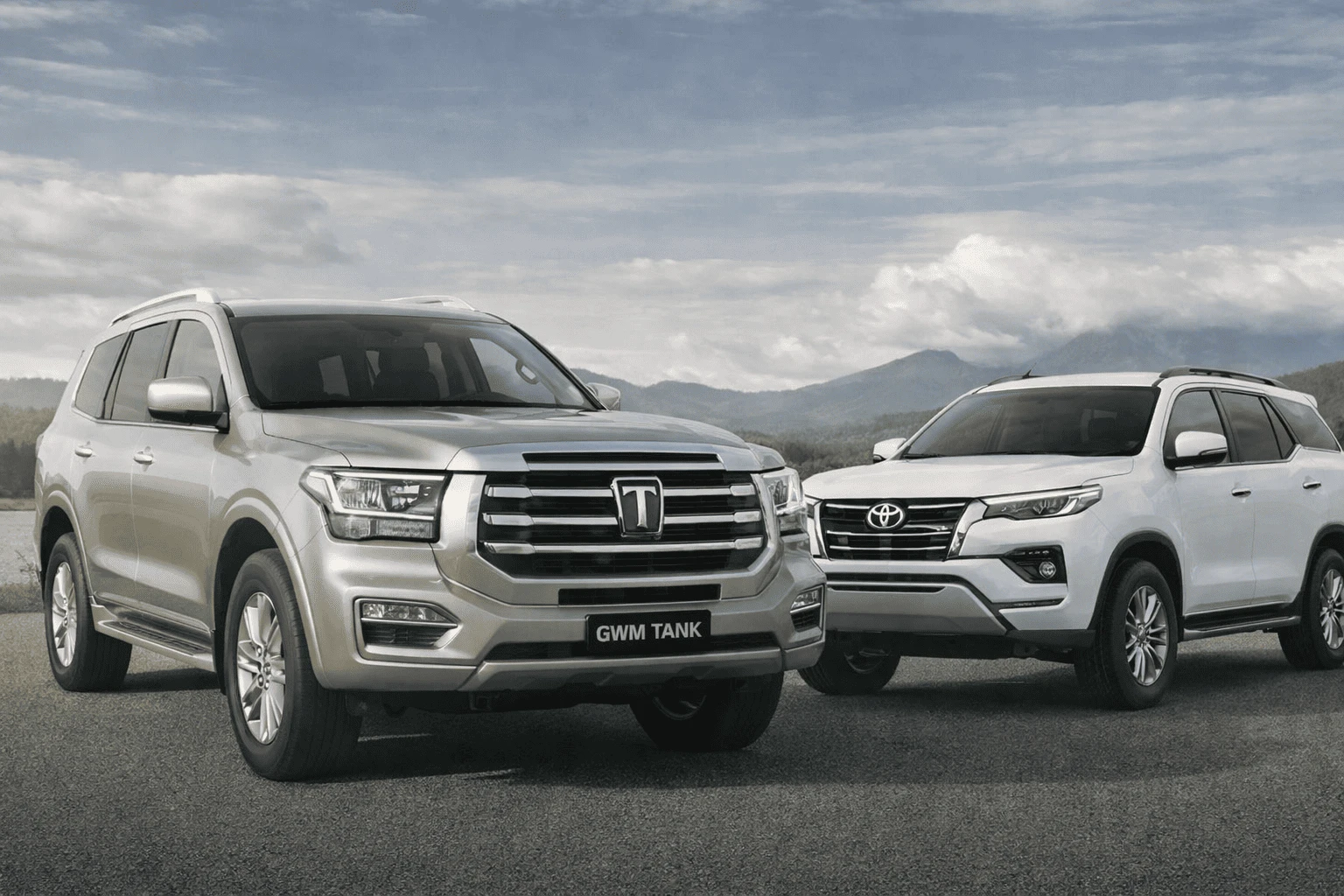
The arrival of the GWM Tank 500 HEV has introduced something completely different — a hybrid full-size SUV that offers more power, more features, and better fuel efficiency on paper. Naturally, this has sparked one big question among buyers:
Tank 500 HEV vs Fortuner GR-S — which one actually makes more sense in Pakistan?
Both SUVs sit in a similar price range, but they take very different approaches:
This comparison breaks down everything that matters — price, specs, mileage, features, and real-world usability — so you can make the right decision.

Here’s a side-by-side snapshot to quickly understand how these two SUVs stack up:
| Specification | GWM Tank 500 HEV | Toyota Fortuner GR-S |
|---|---|---|
| Price (Ex-Factory) | ~ PKR 20.5 million | ~ PKR 20.6 million |
| Engine | 2.0L Turbo + Hybrid | 2.8L Turbo Diesel |
| Power | 342 HP | 201 HP |
| Torque | 648 Nm | 500 Nm |
| Transmission | 9-Speed Hybrid Automatic | 6-Speed Automatic |
| Fuel Average | 12–14 km/l (city) | 9–11 km/l |
| Drive Type | Full-Time 4WD | Part-Time 4WD |
| Segment | Full-Size SUV | Mid-Size SUV |
| Key Highlight | Hybrid + Luxury + Power | Reliability + Resale |
At a glance, the Tank 500 HEV clearly dominates on paper — more power, more torque, better fuel efficiency, and a larger body.
However, numbers don’t tell the full story.
The Fortuner GR-S still brings:
This is why the choice isn’t as simple as “more specs = better SUV.”
On paper, both SUVs sit in almost the same price bracket, but the real cost of ownership tells a slightly different story.
| Price Category | GWM Tank 500 HEV | Toyota Fortuner GR-S |
|---|---|---|
| Ex-Factory Price | PKR 20,500,000 | PKR 20,600,000 |
| On-Road (Filers) | ~ PKR 22.0 – 23.0 M | ~ PKR 23.5 – 24.0 M |
| On-Road (Non-Filers) | ~ PKR 24.0 – 25.0 M | ~ PKR 26.5 – 27.5 M |
| Assembly | Local (Sazgar) | Local (Indus Motors) |
*Prices vary by city, registration, and taxes.
Another important factor is what you get for the price:
Winner: Tank 500 HEV
You’re paying roughly the same — but getting:
The Fortuner only makes financial sense if your priority is resale value and long-term market confidence, not upfront value.
This is where the difference between these two SUVs becomes very clear. They take completely different approaches.
The Tank 500 HEV focuses on modern hybrid performance, while the Fortuner GR-S sticks with a traditional diesel setup that’s built for durability.
| Specification | GWM Tank 500 HEV | Toyota Fortuner GR-S |
|---|---|---|
| Engine Type | 2.0L Turbo + Hybrid Motor | 2.8L Turbo Diesel |
| Max Power | 342 HP | 201 HP |
| Max Torque | 648 Nm | 500 Nm |
| Transmission | 9-Speed Hybrid Automatic | 6-Speed Automatic |
| Drive System | Full-Time 4WD | Part-Time 4WD |
| 0–100 km/h | ~7.3 seconds | ~10.5 seconds |
Tank 500 HEV
Fortuner GR-S
If you’re used to older diesel SUVs, the Fortuner will feel familiar.
But if you want something that feels more refined and powerful, the Tank 500 stands out immediately.
Winner: Tank 500 HEV
It’s simply on another level in terms of:
The Fortuner still holds value for its rugged character, but in pure performance, it can’t match the hybrid setup.
Fuel economy is a major deciding factor in Pakistan, especially with rising fuel prices. This is where the hybrid vs diesel difference really starts to matter.
| Driving Condition | GWM Tank 500 HEV | Toyota Fortuner GR-S |
|---|---|---|
| City Average | 12–14 km/l | ~9 km/l |
| Highway Average | 13–15 km/l | 10–12 km/l |
| Fuel Type | Petrol (Hybrid) | Diesel |
| Fuel Tank | 65 Litres | 80 Litres |
Tank 500 HEV
Fortuner GR-S
Winner: Tank 500 HEV
It clearly wins for:
The Fortuner only stands out if your priority is long-distance range, not daily fuel savings.
This is one of the most noticeable differences between the two — the Tank 500 is simply a bigger SUV, and that directly affects comfort, presence, and practicality.
| Specification | GWM Tank 500 HEV | Toyota Fortuner GR-S |
|---|---|---|
| Length | 5,078 mm | 4,795 mm |
| Width | 1,934 mm | 1,855 mm |
| Height | 1,905 mm | 1,835 mm |
| Wheelbase | 2,850 mm | 2,745 mm |
| Seating | 7-Seater | 7-Seater |
| Segment | Full-Size SUV | Mid-Size SUV |
Tank 500 HEV

Fortuner GR-S

The cabin is more compact in comparison
The third row is best for:
Still comfortable in the first two rows, but not as roomy overall
This is where the gap between these two SUVs becomes very obvious. One focuses on modern luxury and tech, while the other sticks to a more practical, no-nonsense setup.
| Feature | GWM Tank 500 HEV | Toyota Fortuner GR-S |
|---|---|---|
| Infotainment Screen | 14.6-inch | 9-inch |
| Instrument Cluster | 12.3-inch Digital | 4.2-inch TFT |
| Head-Up Display (HUD) | Yes | No |
| Panoramic Sunroof | Yes | No |
| Wireless Charging | Yes | No |
| Seat Ventilation/Heating | Yes (Front) | No |
| Memory Seats | Yes | No |
| Ambient Lighting | Yes | No |
| 360° Camera | Yes | Yes |
Winner: Tank 500 HEV
It offers:
The Fortuner feels reliable, but in this category, it simply can’t compete.
Safety is one area where the difference isn’t just noticeable — it’s significant, especially considering the price bracket.
| Safety Feature | GWM Tank 500 HEV | Toyota Fortuner GR-S |
|---|---|---|
| Airbags | 6 (Front, Side, Curtain) | 3 (Driver, Passenger, Knee) |
| ADAS (Driver Assistance) | Yes — Full Suite | No |
| Blind Spot Monitoring | Yes | Yes |
| Rear Cross Traffic Alert | Yes | Yes |
| Lane Departure Warning | Yes | No |
| Automatic Emergency Braking | Yes | No |
| 360° Camera | Yes | Yes |
| Tyre Pressure Monitoring | Yes | No |
| Stability Control | Yes | Yes |
Winner: Tank 500 HEV
It clearly leads with:
The Fortuner remains dependable, but it doesn’t offer the same level of modern protection.
This is where the decision becomes less about features and more about long-term practicality in Pakistan.
| Factor | GWM Tank 500 HEV | Toyota Fortuner GR-S |
|---|---|---|
| Resale Value | Uncertain (new in market) | Very strong, well-proven |
| Service Network | Limited (major cities) | Nationwide |
| Parts Availability | Mostly urban centres | Easily available everywhere |
| Warranty | 10-year engine / 8-year battery | 3 years / 100,000 km |
| Maintenance Type | Hybrid (specialised) | Conventional diesel |
| Mechanic Familiarity | Limited | Very high |
Winner: Fortuner GR-S
It dominates in:
The Tank 500 is promising, but it’s still new and unproven in Pakistan’s market.
At this point, the choice really comes down to your usage, priorities, and lifestyle. Both SUVs are good — but for very different types of buyers.
In simple terms:
If you want a luxury experience + performance + fuel savings, the Tank 500 makes more sense.
Prefer something that:
In simple terms:
If you want reliability + peace of mind + strong resale, the Fortuner is the safer choice.
The Tank 500 HEV vs Fortuner GR-S comparison isn’t about which SUV is better overall — it’s about which one fits your needs better in Pakistan.
The Tank 500 HEV clearly leads when it comes to:
It feels like a next-generation SUV, especially for city users who want comfort, tech, and lower running costs.
On the other hand, the Fortuner GR-S continues to dominate in areas that matter deeply in the local market:
It may feel outdated in features, but it still delivers where many buyers feel safest — dependability and market trust.
At the end of the day, both SUVs justify their price, just in very different ways.

I am Zeenat, an SEO Specialist and Content Writer specializing in on-page and off-page SEO to improve website visibility, user experience, and performance.
I optimize website content, meta elements, and site structure, and implement effective off-page SEO strategies, including link building and authority development. Through keyword research and performance analysis, I drive targeted organic traffic and improve search rankings.
I create high-quality, search-optimized content using data-driven, white-hat SEO practices, focused on delivering sustainable, long-term growth and improved online visibility.
Fuel prices, new car launches, and growing interest in cleaner transport have made many buyers compa
25 May 2026
When it comes to compact sedans, few rivalries are as deeply rooted in Pakistan’s automotive c
21 January 2026
When you're in the market for a car, one of the first decisions you’ll face is whether to go f
3 December 2025
Be the first to share your thoughts
No comments yet. Be the first to comment!
Share your thoughts and join the discussion below.

(1).webp&w=3840&q=75)