* All product/brand names, logos, and trademarks are property of their respective owners.
If you think modern cars are already smart because they have touchscreens, parking sensors, and voice assistants, you’re absolutely right — but that’s only the beginning. The real revolution happening in the auto tech world isn’t just electric engines or self-driving features. It’s communication. Cars are learning how to talk.
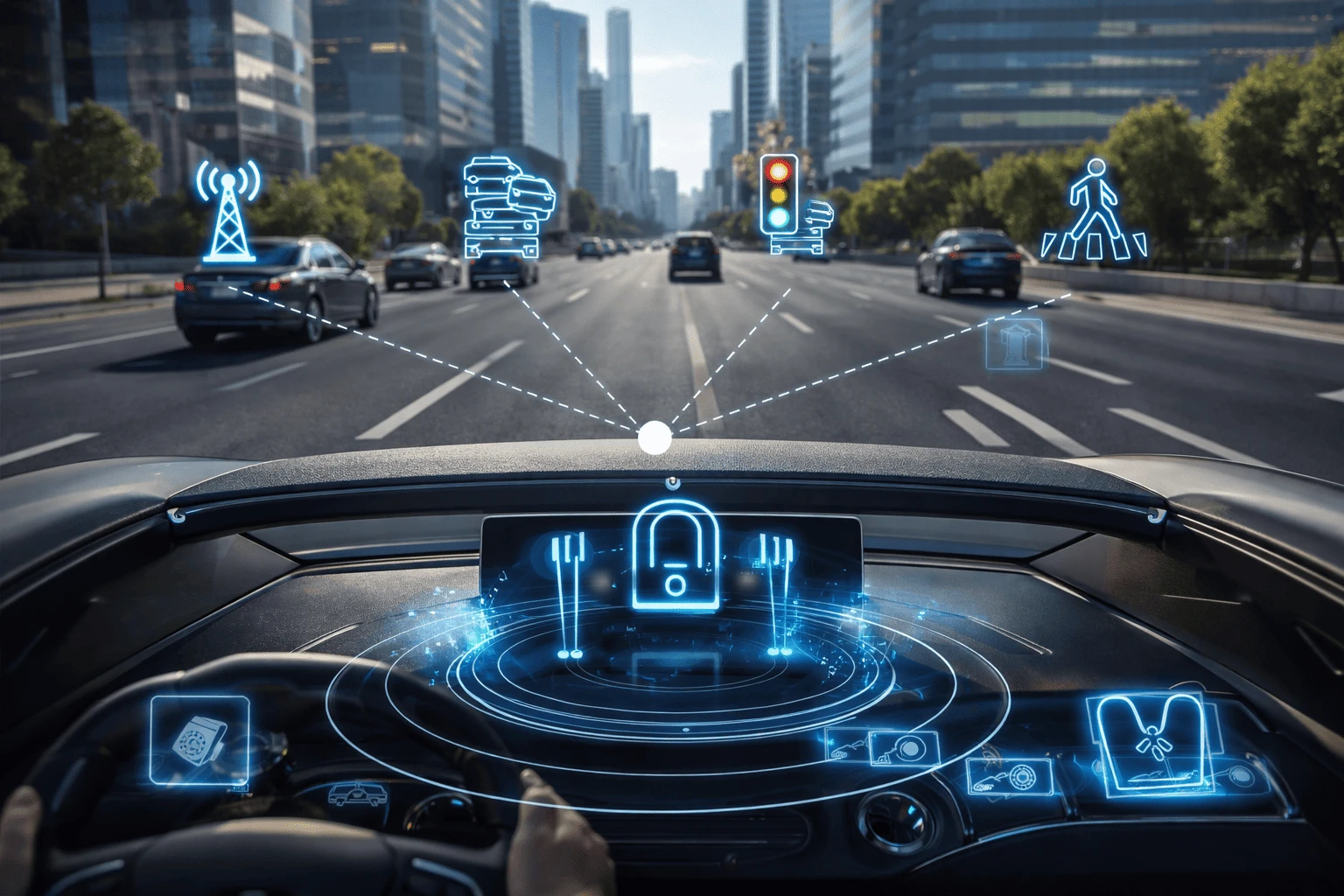
Not in a sci-fi way with personalities and jokes, but in a practical, life-saving way where vehicles can exchange real-time data with other cars, traffic lights, road systems, cloud networks, and even pedestrians. This is the foundation of connected cars technology, and at the center of it all is 5G in the automotive industry.
Think of 5G as the nervous system of a modern vehicle. Just like your body reacts instantly when you touch something hot, 5G allows vehicles to react instantly to what’s happening around them. This capability powers Vehicle-to-Everything (V2X) communication, a system where cars continuously share and receive information from their environment. Why does this matter? Because driving is full of split-second decisions. A car brakes suddenly. A pedestrian steps into a blind spot. An ambulance approaches from behind. Human reflexes are limited — but connected systems can react in milliseconds.
That’s the promise of 5G connected vehicles: safer roads, smoother traffic, smarter cities, and eventually, reliable autonomous driving. Let’s break down how it all works in simple terms.
A connected vehicle is more than a car with internet access. It’s part of a larger mobility network. Through V2X communication, vehicles send and receive constant updates about speed, direction, road conditions, hazards, and more. Here’s how cars actually “talk.”

1) Vehicle-to-Vehicle (V2V)
V2V allows cars to directly exchange information such as speed, position, and braking status. Imagine you’re driving on a highway and a vehicle ahead suddenly brakes hard. Even before you physically see it, your car receives an instant alert: emergency braking ahead. That early warning can trigger a dashboard alert or even automatic braking. This kind of car-to-car communication significantly reduces rear-end collisions and improves reaction time beyond human capability.
2) Vehicle-to-Infrastructure (V2I)
V2I connects vehicles to traffic lights, road signs, toll booths, parking systems, and smart intersections. For example, your car might receive a message saying, “Traffic light turning red in 3 seconds,” or “Accident reported 1 km ahead.” Instead of reacting late, your vehicle adjusts smoothly. In smart cities, this improves traffic flow, reduces fuel consumption, and lowers emissions — all while enhancing safety.
3) Vehicle-to-Pedestrian (V2P)
V2P is designed to protect vulnerable road users. Through smartphones or wearable devices, pedestrians can be detected even if they are not visible to the driver. Picture a child stepping out from between parked cars. Even if your camera doesn’t detect them immediately, a connected system could send a warning to your vehicle in real time. This expands the vehicle’s awareness beyond what sensors alone can see.
4) Vehicle-to-Network (V2N)
V2N connects cars to the cloud. This enables:
Real-time traffic updates
Weather alerts
Remote diagnostics
Over-the-air software updates
Predictive maintenance
For example, if black ice is reported ahead, your vehicle can receive the alert instantly and suggest an alternative route. Together, these four communication modes form the backbone of automotive connectivity.
Some connected features existed with 4G, like navigation or streaming music. But when it comes to safety-critical communication, 4G simply isn’t fast or reliable enough. Here’s why 5G changes everything.
Ultra-Low Latency
Latency is the delay between sending and receiving data.
4G latency: roughly 50–100 milliseconds
5G latency: as low as 1–4 milliseconds
That difference may sound small, but at highway speeds, even a fraction of a second matters. Faster communication means faster braking responses and safer roads.
High Bandwidth (eMBB)
Modern vehicles — especially autonomous ones — generate enormous amounts of data from cameras, radar, and LiDAR. Some estimates suggest autonomous cars can produce terabytes of data per hour. 5G’s high bandwidth allows vehicles to process and share essential data efficiently, supporting advanced navigation and real-time decision-making.
Massive Connectivity (mMTC)
In dense urban areas, thousands of connected devices operate simultaneously — cars, phones, traffic systems, sensors. 5G can support up to one million devices per square kilometer. That prevents network congestion, which is critical in busy cities where reliability matters most.
Network Slicing
One of 5G’s most powerful features is network slicing. It creates dedicated “lanes” within the network. Safety messages like collision warnings get top priority, while entertainment data (like video streaming) gets lower priority. This ensures critical communication is never delayed. In short, 5G is not just a faster 4G — it’s a network designed for intelligent machines.
The idea of connected transportation might sound futuristic, but real-world use cases are already emerging across the globe.

Platooning
Platooning involves trucks traveling closely together using synchronized communication. The lead vehicle controls speed and direction, while following trucks react instantly through V2V communication.
Benefits include reduced fuel consumption, lower emissions, and improved road capacity. Logistics companies in the US and Europe are already testing this technology.
Cooperative Perception
This allows vehicles to share sensor data to “see” beyond physical obstacles.
If another vehicle detects a cyclist around a corner, that information can be shared instantly with nearby cars. This extends each vehicle’s awareness and enhances safety — especially for autonomous driving systems.
Emergency Vehicle Priority
Ambulances equipped with V2X can communicate with traffic lights to turn them green before arrival. Nearby vehicles can receive alerts to move aside. This reduces response time and can literally save lives.
Predictive Maintenance
Through V2N communication, vehicles send real-time diagnostic data to manufacturers or fleet operators. Instead of waiting for parts to fail, systems can detect potential issues early — whether it’s battery health in electric vehicles or brake system performance. This reduces downtime and unexpected breakdowns.
With constant connectivity comes serious responsibility. Security is not optional — it’s essential.
Cybersecurity Standards
Global organizations such as 3GPP have developed strict protocols to ensure messages are authentic and secure. Vehicles must verify that incoming alerts are legitimate.
Encryption & PKI
Advanced encryption methods like AES 256-bit encryption protect data in transit. Public Key Infrastructure (PKI) ensures every vehicle has a secure digital identity, preventing unauthorized access.
Data Privacy
To address tracking concerns, the industry uses pseudonymization. Vehicles frequently change digital identifiers so that data cannot easily be tied to individual drivers.
Global Deployment Trends
The United States, European Union, China, and parts of the Middle East are investing heavily in smart mobility infrastructure. However, challenges remain — including infrastructure costs, regulatory alignment, and standardization. Despite these hurdles, momentum is strong. Automakers, telecom providers, and governments are aligning around the future of connected transportation.
Cars are no longer isolated machines operating independently. They are becoming intelligent participants in a larger mobility ecosystem. Through 5G, automotive connectivity, and V2X communication, vehicles can share real-time data, prevent accidents, improve traffic flow, and support autonomous driving.
This shift impacts everyone:
Drivers gain safer roads.
Cities gain smarter traffic systems.
Automakers move toward software-defined vehicles.
Emergency services respond faster.
The transformation won’t happen overnight. Infrastructure must expand. Regulations must align. Security must remain airtight. But the foundation is already being built. The future of transportation isn’t just electric. It’s connected, intelligent, and cooperative. Cars are starting to talk — and when they do, the roads will never be the same.
Related Article
Latest EV Technology: What’s New in Electric Cars

Mushraf Baig is a content writer and digital publishing specialist focused on data-driven topics, monetization strategies, and emerging technology trends. With experience creating in-depth, research-backed articles, He helps readers understand complex subjects such as analytics, advertising platforms, and digital growth strategies in clear, practical terms.
When not writing, He explores content optimization techniques, publishing workflows, and ways to improve reader experience through structured, high-quality content.
Pakistani car buyers are hearing more about EVs, hybrids, plug-in hybrids, range extenders, new ener
4 June 2026
Auto tech innovations in Pakistan are changing the way people think about driving, safety, fuel savi
26 May 2026
Not long ago, driving meant full control—hands on the steering wheel, eyes on the road, and ev
1 May 2026
Be the first to share your thoughts
No comments yet. Be the first to comment!
Share your thoughts and join the discussion below.