* All product/brand names, logos, and trademarks are property of their respective owners.
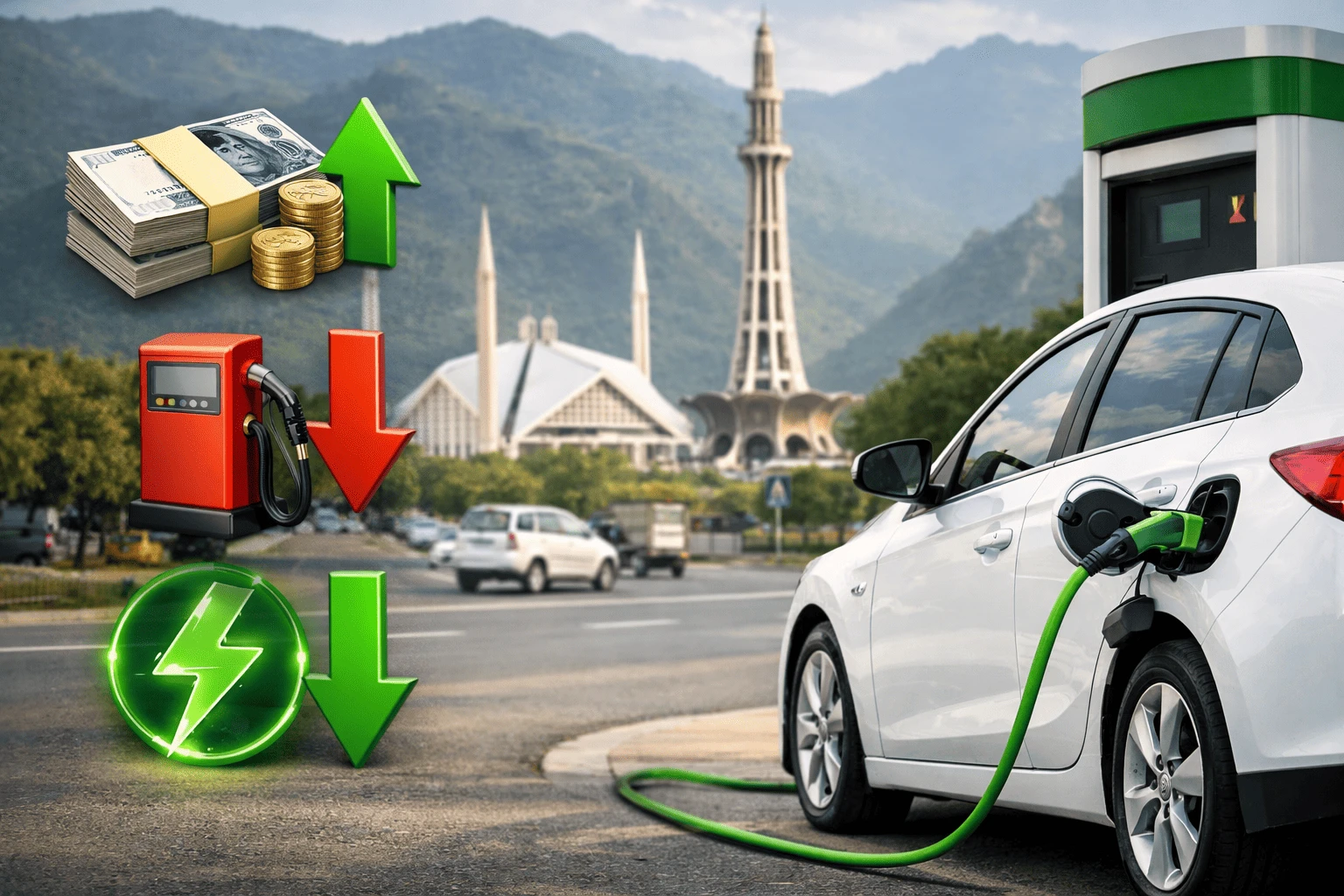
Petrol prices in Pakistan have been anything but stable. For many car owners, the monthly fuel bill has quietly become one of their biggest expenses. Naturally, this has pushed people to look for alternatives—and electric cars in Pakistan are starting to get serious attention.
At first glance, EVs seem like the perfect solution. Lower running costs, no fuel stops, and a quieter driving experience. But the real question is more practical:
Are electric cars actually worth it in Pakistan’s current conditions?
Because beyond the hype, there are real concerns—charging infrastructure, electricity reliability, high upfront costs, and day-to-day usability.
In this guide, we’ll break it all down in simple terms so you can decide whether switching to an electric car makes sense for your lifestyle.
Electric cars are still a small part of Pakistan’s overall car market, but they are no longer just a niche idea. The category is becoming more visible because more brands are showing EVs locally, public awareness is improving, and the government has refreshed its policy focus through the New Energy Vehicles Policy 2025–30.
At the policy level, Pakistan’s newer EV framework also makes it clear that the state wants broader adoption than the older, slower rollout achieved under earlier EV targets. The Ministry of Industries & Production lists the New Energy Vehicles Policy 2025–30 as an active policy document, following earlier EV policy efforts for four-wheelers and other vehicle categories.
That said, the market is still in the “early growth” stage, not the “fully mature” stage. Buyers in Pakistan are seeing more options than before, but the ecosystem around those cars—charging access, model variety, after-sales confidence, and resale visibility—is still catching up. So while EVs are now part of the real buying conversation, they are not yet the obvious default choice for most households. This is exactly why the “worth it or not” question matters in Pakistan more than in markets with mature charging networks. The latest local market coverage also reflects this shift, describing a broader 2026 EV lineup than in previous years.
This is the section most buyers care about. In Pakistan, the biggest EV selling point is usually running cost, not the sticker price. That matters because while fully electric models are still expensive upfront, they can be much cheaper to drive over time.
At the same time, petrol prices in Pakistan keep changing through official fortnightly revisions. The Petroleum Division’s published notices show how often fuel costs move, and on February 16, 2026, a revision pushed petrol to Rs258.17 per litre for that period. That kind of volatility is one reason many buyers are rethinking long-term fuel dependence.
| Factor | Electric Car | Petrol Car |
|---|---|---|
| Upfront price | Higher | Usually lower |
| Energy/fuel cost per km | Lower | Higher |
| Routine maintenance | Lower | Higher |
| Engine oil changes | No | Yes |
| Best use case | Daily city driving | Mixed city + long trips |
| Infrastructure dependence | Charging access needed | Petrol pump network already everywhere |
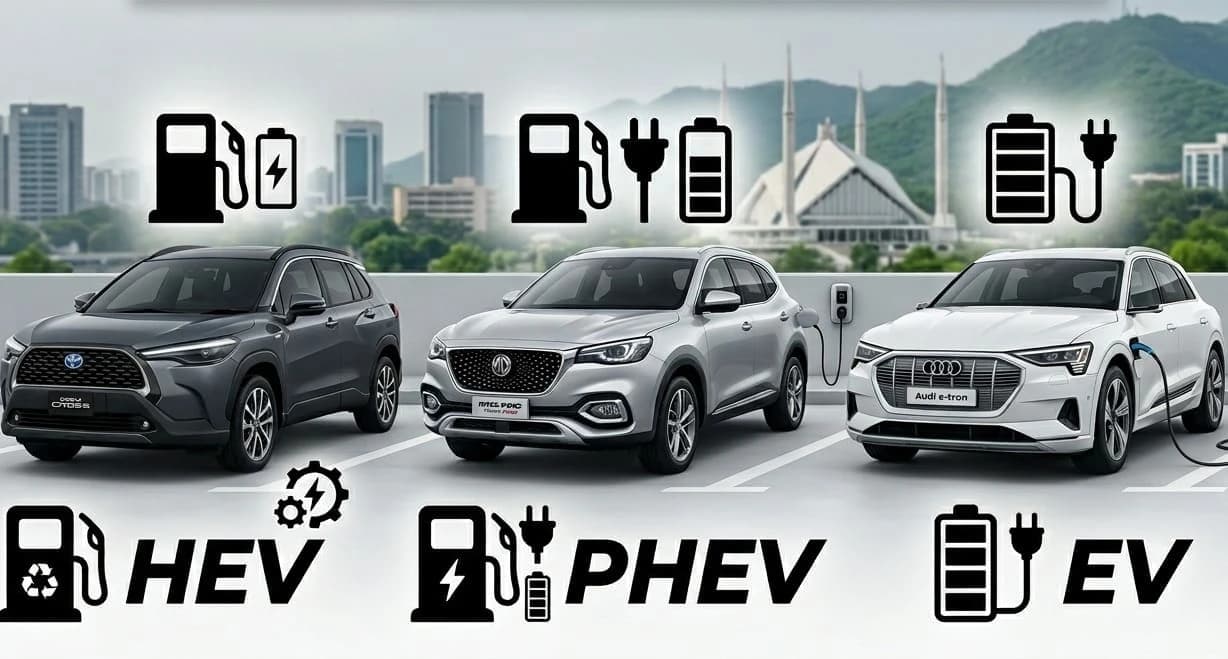
Related EV vs Hybrid vs Petrol: Which Option Makes the Most Sense in Pakistan
Below is an illustrative example, not a universal rule. I’m using a 1,000 km monthly driving distance, a home-charging electricity assumption of Rs60 per unit, and a petrol-car assumption of 14 km/litre. For EV efficiency, I’m using a ballpark based on listed battery/range figures from current Pakistan-market EVs like the MG 4 and BYD Atto 3, which work out to roughly 6.8–6.9 km per kWh on paper. Real-world results can be lower or higher depending on traffic, AC use, driving style, and battery size.
| Example for 1,000 km/month | Electric Car | Petrol Car |
|---|---|---|
| Efficiency used | 6.8 km/kWh | 14 km/litre |
| Energy/fuel needed | ~147 kWh | ~71 litres |
| Cost assumption | Rs60/kWh | Rs258.17/litre |
| Estimated monthly cost | ~Rs8,820 | ~Rs18,440 |
In this example, the EV saves roughly Rs9,600 per month on energy alone. That is a meaningful difference for people who drive daily in Karachi, Lahore, Islamabad, or other major cities.
The ownership math in Pakistan usually looks like this:
So, if someone is buying purely on purchase price, petrol still wins more often. But if someone is thinking about 3–5 years of ownership, especially with regular daily commuting, an EV starts making a much stronger case.
Electric vehicles are gaining attention for a reason. When you look beyond the hype, there are some clear, practical advantages—especially in Pakistan’s current situation.
This is the biggest win.
For someone driving regularly, this alone can justify considering an EV.
Electric cars have fewer moving parts compared to petrol cars.
Over time, this reduces both maintenance cost and hassle.
EVs feel very different on the road:
If you mostly drive in urban areas, the experience is noticeably better.
Electric cars are especially suited for city driving in Pakistan:
In cities like Karachi, Lahore, and Islamabad, this becomes a real advantage.
While Pakistan’s electricity isn’t fully clean, EVs still help:
This matters more in congested cities where smog is already a concern.
With an EV:
For people with home solar setups, this becomes a major long-term benefit.
Overall, electric cars offer real, practical benefits—especially for city users who can charge at home and drive regularly.
But that’s only one side of the story.
Read this article on Autodost Toyota Hilux Goes Electric: First-Ever EV Pickup Launching December 2025
While electric cars sound great on paper, the reality in Pakistan comes with some very practical challenges. This is where most buyers hesitate—and rightly so.
Public charging is still developing.
This means you can’t rely on public charging the same way you rely on fuel stations.
This is a uniquely Pakistani concern.
If electricity isn’t stable in your area, EV ownership becomes less convenient.
EVs are still expensive in Pakistan.
Even if running costs are lower, the entry barrier is high.
The resale market for EVs is still immature.
For many Pakistani buyers, resale value is a major factor—and EVs still lag here.
EVs are not ideal for frequent intercity travel (yet).
For example, a trip from Karachi to Lahore or even shorter intercity routes requires careful planning, unlike petrol cars.
Not everyone can install a home charger.
This is one of the biggest real-world limitations in urban Pakistan.
These challenges don’t mean EVs are a bad choice—but they do mean that they’re not for everyone (yet).
Charging is where the EV experience becomes very real—and very different from petrol cars. In Pakistan, your experience will largely depend on where you live and how you plan to charge.
| Aspect | Reality in Pakistan | What It Means for You |
|---|---|---|
| Home Charging | Most common and practical option | Best if you have a house with dedicated parking |
| Charging Time (Home) | 6–10 hours (overnight) | Works well if you charge while sleeping |
| Fast Charging | Limited availability in major cities | Useful but not widely accessible yet |
| Public Charging Stations | Available in Karachi, Lahore, Islamabad (limited) | Not reliable enough to depend on daily |
| Cost of Charging | Cheaper than petrol (especially at home) | Major long-term savings |
| Load Shedding Impact | Can interrupt or delay charging | Requires planning or backup solutions |
| Apartment Living | Charging setup is difficult | Major limitation for many urban users |
| Highway Charging | Very limited | Long-distance travel needs planning |
Not everyone will benefit from an EV right now. In Pakistan, the value of an electric car depends heavily on your lifestyle, driving habits, and living situation.
Here’s a clear breakdown to help you decide:
Best for These People
| User Type | Why It Works |
|---|---|
| City commuters | Daily driving = maximum savings on fuel |
| People with home charging | Convenient overnight charging |
| High-mileage drivers | More driving = more cost savings |
| House owners | Easier charger installation |
| Solar users | Can reduce the charging cost even further |
If your daily routine is mostly (within the city), an EV can be a very smart long-term choice.
So, are electric cars in Pakistan actually worth it?
The honest answer is: it depends on your situation—but for the right user, they absolutely can be.
Electric cars make the most sense in Pakistan when:
In these cases, the lower running cost + smoother driving experience make EVs a smart move.
Petrol cars are still the safer choice if:
Right now, petrol cars are still more practical for all-around use in Pakistan.
Electric cars are not just a trend—they’re clearly part of the future. But in Pakistan, we’re still in the early transition phase.
That means:
If your setup supports it, switching to an EV can save you money and improve your daily driving experience. If not, waiting a few years for better infrastructure might be the smarter move.
Want to know the Best electric vehcicle Read this: Why the BMW iX3 Is One of the Best Electric SUVs You Can Buy

I am Zeenat, an SEO Specialist and Content Writer specializing in on-page and off-page SEO to improve website visibility, user experience, and performance.
I optimize website content, meta elements, and site structure, and implement effective off-page SEO strategies, including link building and authority development. Through keyword research and performance analysis, I drive targeted organic traffic and improve search rankings.
I create high-quality, search-optimized content using data-driven, white-hat SEO practices, focused on delivering sustainable, long-term growth and improved online visibility.
Buying a car in Pakistan isn’t just about the price tag at the showroom. The real financial st
19 February 2026
Every time we get behind the wheel, we’re trusting more than just our reflexes — we&rsqu
17 January 2026
The global shift toward electric vehicles (EVs) isn’t slowing down — and in 2026, it&rsq
7 January 2026
Be the first to share your thoughts
No comments yet. Be the first to comment!
Share your thoughts and join the discussion below.
.webp&w=3840&q=75)
(1).webp&w=3840&q=75)