FIA Sporting Changes & Crew Welfare Rules
One of the biggest headlines for 2026 is also one of the most human: mandatory rest hours. After feedback about extreme itineraries, a new rule now requires a minimum of 10 rest hours for crews between days. Over the course of a rally, total rest hours will roughly equal competition hours.
Why does this matter on the stopwatch? Because fatigue doesn’t just make drivers slower — it makes them messy. It turns clean pacenotes into hesitation, and hesitation into mistakes. It can also affect co-drivers, who are processing information at high speed for hours. With this change, the FIA is trying to keep rallies intense while reducing the “survival mode” feeling that can build across a brutal weekend.
There’s also an important sporting update tied to reliability and flexibility: engine replacement after the rally starts is now allowed for competitors, excluding those nominated for manufacturer points. The trade-off is heavy: a 60-minute penalty plus ineligibility for event points. In other words, you can keep running (useful for experience, exposure, and learning), but you pay for it in the results.

Service Park & Technical Adjustments
Another change that can quietly reshape rallies is the reduced midday service window. The FIA has cut it from 40 minutes back to 30 minutes, returning to the pre-hybrid-era standard. That 10-minute difference is huge for teams. Midday service is where mechanics fix damage, adjust setups, and try to stop small issues from becoming big ones. Less time means tougher choices:
-
Do you fix the obvious damage, or chase a hidden issue?
-
Do you change a part now, or risk it lasting one more loop?
-
Do you optimize performance, or prioritize survival?
For drivers, it changes risk management. If you know the team has less time to repair your mistake, you may push differently — especially on rough rallies where underbody hits, punctures, and suspension wear are normal. A small but spicy addition for 2026 is the new chicane penalty: a 5-second penalty applies if a crew completely displaces a chicane element from its marked position. Five seconds doesn’t sound like much—until you remember some rallies are decided by single-digit gaps after hundreds of competitive kilometers.
2026 WRC Calendar Updates
The calendar stays at 14 rounds, but several changes matter for flow and fairness:
-
Croatia Rally returns, replacing the Central European Rally. Croatia is typically a precision-heavy event where commitment and clean lines win time.
-
Rally Japan moves from November to May, aiming to improve logistical flow and reduce late-season distortions that can impact championship leaders.
-
Italy remains in October, but its official title changes from “Rally Italia Sardegna” to “Rally Italia.” Long-term, there’s growing talk that the event’s future could shift toward Rome from 2027.
Put together, 2026 feels familiar but meaningfully refreshed — and those “small” changes are exactly what can swing a title fight.
The Stars, Teams & Championship Battle
Toyota Gazoo Racing – Rebuilding After Rovanperä
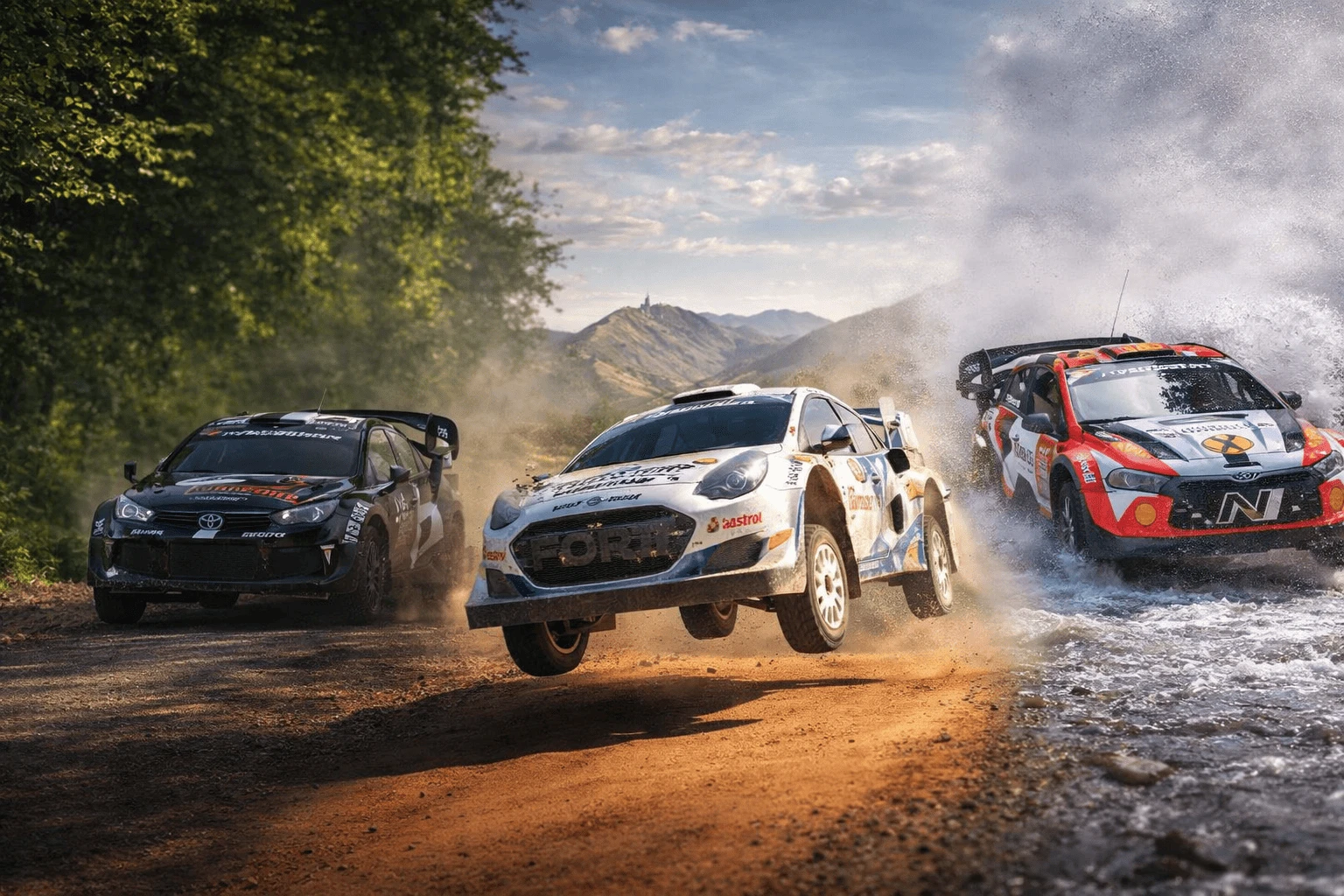
Toyota arrives with serious firepower, but the big headline is Kalle Rovanperä’s exit to pursue open-wheel racing. That changes Toyota’s feel: you lose not only speed, but a driver who could turn a “bad weekend” into big points. The new Toyota group is:
The storyline here is balance. Evans becomes the likely backbone of the title push, while Solberg’s full-time step up is a major “future meets now” move. Katsuta and Pajari add depth across surfaces, and Ogier’s partial schedule is a wild card: even part-time, he can win rallies and disrupt the points picture for everyone else.
Hyundai Shell Mobis – Neuville’s Big Opportunity
Hyundai’s 2026 narrative starts with a gap: Ott Tänak’s indefinite break. That’s not just a personnel note — it changes how Hyundai attacks a season, because Tänak is the type of driver who can pull a rally out of chaos on pure pace.
Hyundai’s lineup features:
-
Thierry Neuville
-
Adrien Fourmaux
-
Esapekka Lappi
-
Dani Sordo
-
Hayden Paddon
Neuville becomes the clear spearhead. Fourmaux moving into a full-time role is one of the most important “next generation” steps on the grid, while Lappi, Sordo, and Paddon bring rally-specific strength and experience. In WRC, that depth can be priceless when conditions get weird or when a team needs a steady points haul rather than heroic risk.
M-Sport Ford – Youth Movement
M-Sport Ford leans hard into a development approach in 2026, featuring an all–Motorsport Ireland Rally Academy full-time lineup:
For M-Sport, the season is likely about building talent, gaining experience, and grabbing results when opportunities appear. And opportunities always appear in rallying: changing weather, tyre gambles, and attrition can turn an “underdog weekend” into a podium. If 2026 gets chaotic, M-Sport could be the team that benefits most.
WRC Rules & Points System Explained (Beginner-Friendly Guide)
How Rally Weekends Work
WRC is a race against the clock across multiple special stages (closed roads). Cars start one by one, and times are added up. The lowest total time wins. Between stages, crews drive road sections on public roads while following traffic laws. Service parks are where teams do repairs and setup changes — and in 2026, that tighter 30-minute midday service can heavily influence strategy. Surfaces vary wildly: gravel, tarmac, snow, and mixed conditions. That’s why WRC rewards versatility and decision-making, not just outright speed.
Points Breakdown & Super Sunday
Standard points go to the top 10 overall finishers: 25-17-15-12-10-8-6-4-2-1 Then come the bonus battles:
-
Super Sunday: up to 5 bonus points for the fastest crews on the final day, separate from overall classification.
-
Wolf Power Stage: the final stage offers 5-4-3-2-1 bonus points.
These bonus points keep rallies alive until the end. Even if a driver has a rough Friday, they can still fight hard on Sunday to salvage meaningful points — which can decide championships over 14 rounds.
How Penalties Can Decide a Championship
Some 2026 rules are especially “small penalty, big consequences”:
-
Engine replacement after the start (non-manufacturer-nominated competitors): 60-minute penalty + no event points.
-
Chicane displacement: automatic 5-second penalty if a crew completely moves an element out of position.
In a sport where gaps can be tiny, penalties like these aren’t just footnotes — they’re title-shaping moments.
Predictions & What to Watch in 2026
2026 feels like a season where the smartest team could beat the fastest team. With tighter service time and more structured rest, expect fewer “survival rallies” and more events decided by strategy, Sunday points, and mistake avoidance.
Here are the key watch points:
-
Can Toyota stay dominant without Rovanperä? Evans’ consistency and Solberg’s growth will be crucial, while Ogier’s partial program could reshape the points story.
-
Is this Neuville’s best shot? With Tänak out, Hyundai’s path depends on Neuville converting speed into clean weekends and Fourmaux delivering steady support.
-
Will M-Sport steal moments? If the season brings unpredictable weather and high attrition, the youth-heavy lineup could surprise more than once.
-
Sunday points will matter more than ever. Super Sunday + Power Stage bonuses can swing momentum and reward drivers who keep pushing even after setbacks.
Most of all, remember what 2026 represents: the end of Rally1 as we know it. Teams aren’t just fighting for trophies — they’re fighting for the narrative and confidence that carries into 2027.
Conclusion: Why 2026 Might Be a Classic
The 2026 WRC season has everything: a “final year of an era” atmosphere, meaningful sporting updates, a refreshed calendar, and a grid full of new dynamics. The FIA’s changes — from 10-hour minimum rest to the tighter 30-minute midday service — won’t just affect comfort; they’ll affect tactics, risk, and results. Add the bonus-point battles of Super Sunday and the Wolf Power Stage, and you’ve got a championship built for drama all the way to the final stage.
Whether you’re a long-time fan or just learning the sport, this is a perfect season to follow closely — because what happens now won’t just crown a champion. It’ll shape who enters 2027 with momentum. Who’s your pick for 2026 — Toyota, Hyundai, or a wildcard upset?
Related Article